Case study · Sample Licensing
The sample nobody gets cleared
Oceanvs Orientalis spent his life on a legendary 1970s psychedelic-rock band worshipped as gods. Then he built a remix on one of their sacred tracks — and hit the fee that ends most stories. He raised the money in a week, from one investor, without a label.
By the numbers
329k
4
$10,000
30%
A record he had to make
Oceanvs Orientalis is not a bedroom hobbyist. 329,000 people a month already listen to him. He has also worshipped one legendary 1970s psychedelic-rock band his entire life — and the remix he built on one of their most sacred tracks was the kind of record that only comes out of that.
Finished. Mixed. Mastered. And completely unreleasable.
The wall: a major-label sample fee
Their catalogue is one of the hardest clearances in music. As far as anyone can establish, only four sample licenses have ever been approved. Getting a yes is the rare part; paying for it is the impossible part.
Option A — the label
Sign the track away. The label fronts the fee, owns the master, recoups first, and takes the upside on a record it had nothing to do with.
Option B — self-fund
Write a five-figure cheque out of pocket, before a single stream, against a release date that does not exist yet.
Neither was actually available. So the record sat.
Option C: sell a slice, keep the record
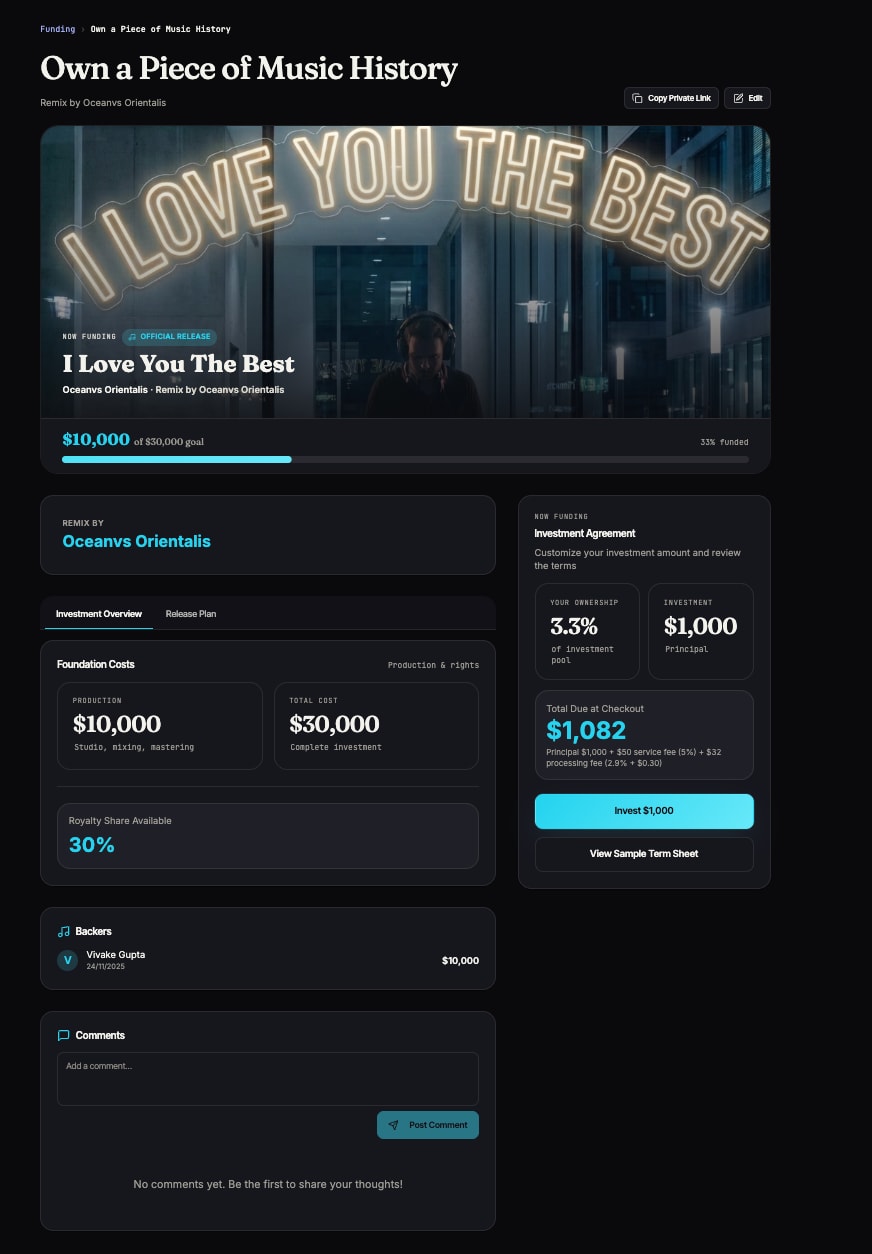
He listed the remix on bushido’s funding tool for accredited investors — not as debt, not as a label deal, but as a share of the future royalties of the derivative work.
Step 01
Clear the framework
bushido’s licensing framework structured the major-label clearance into a defined, investable cost.
Step 02
Price the slice
30% of the derivative work’s royalties, offered against a $30,000 goal — investors buy pro-rata.
Step 03
Meet the right money
A private link, sent to accredited investors who actually care about the catalogue.
One devoted fan funded another
The first cheque came from an accredited investor who was, himself, a devotee of the same band. He wasn’t buying a security abstraction — he was buying 30% of a record he wanted to exist.
Deal terms
- Invested
- $10,000
- Royalty share
- 30%
- Round progress
- 33%
Proceeds applied to the sample-license fee and release promotion.
What the investor actually saw
A single private link: ownership maths, total due at checkout, term sheet, release plan. No deck, no lawyer’s introduction, no three-week back-and-forth.
License paid. Release date set.
- Cleared
The major-label sample fee is paid in full.
- Scheduled
Release date locked; the record goes to Spotify and DSPs worldwide.
- Retained
Oceanvs keeps the master, a majority split of the royalties, and the sync rights. No label, no recoupment.
- Open
Sync: a legally cleared derivative of that catalogue is a rare, pitchable asset for film, TV and advertising.
Where the $10,000 comes back
Streaming services the position. Sync is where a cleared derivative of that catalogue actually pays. Illustrative scenarios on the investor’s 30%:
| Scenario | Net to the track | Investor 30% | On $10k |
|---|---|---|---|
| Streaming only — 5M streams | $17,500 | $5,250 | 0.5× |
| + one independent film placement | $32,500 | $9,750 | 1.0× |
| + one national TV campaign | $92,500 | $27,750 | 2.8× |
| + global brand campaign | $192,500 | $57,750 | 5.8× |
Illustrative only. Figures model plausible net receipts on the derivative work and are not a forecast, a guarantee, or an offer. Actual royalties depend on release performance, DSP rates and sync demand.
In their words
“I don’t need a label to fund the next sample license. I need one investor who gets it.”
bushido turns impossible licenses into fundable assets — so the record decides whether it gets made, not the advance.